ROVER · PRODUCT DESIGN · 2025–26 · IN FLIGHT
Aligning sitter fees with how and when Rover delivers value — to curb diversion and grow per-relationship revenue.
Rover charges a flat 20% (15% in Europe) on every booking — whether it's the first ever with a new client or the 20th with a long-term trusted relationship.
Our internal assessment found Rover delivers ~76% of booking value on a new relationship — but only ~18% on an established one. The fee doesn't reflect this.
Discovery, trust-building, insurance, payment infrastructure, profile visibility. Rover earns its cut.
Owner and sitter know each other well. Rover is mostly the payment rail and safety net. Same cut anyway.
Top 20% of sitters generate 73–77% of total earnings — consistent across all geos. The top 1% alone account for 15–19%.
Top NA sitters are repeat-driven. In the US: 63%. In Canada: 59%. This is the behaviour we wanted to protect and extend.
Source: Analytics deep dive · Sep 2025 · David Argelich
Repeat vs. acquisition split — NA vs. Europe
A previous test cut the sitter fee from 15% to 5% for all recurring bookings in the UK and all dog walking in Spain. After 4 months:
Canada is a closer proxy for the US than UK/ES in terms of repeat booking patterns.
Boarding accounts for 53% of top US sitter earnings. High ABV services are where the fee pain is most acute.
A flat fee cut is a pure margin give-up. The next test needs to be financially neutral or better — higher early fee offsets the reduction on repeat.
Include both new and established sitters. Previous test lacked segmentation to read the signal clearly.
Sitter feedback and the fact that top providers get more than half their earnings from repeat bookings — while still paying the same fee as on a first booking.
By setting up a fee structure that more closely maps how and when Rover delivers value to sitters
Increase top sitter satisfaction and increase Rover take.
Most loyal sitters are better off financially and satisfied with the new structure.
New relationship booking volume is maintained — CBR not significantly hurt.
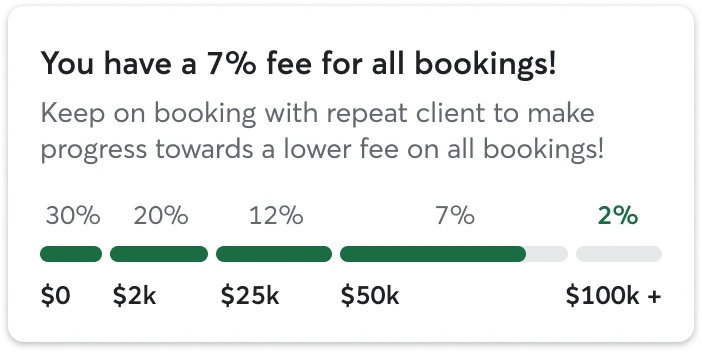
Lower fee on all repeat bookings, higher flat on all first bookings with any client.
✓
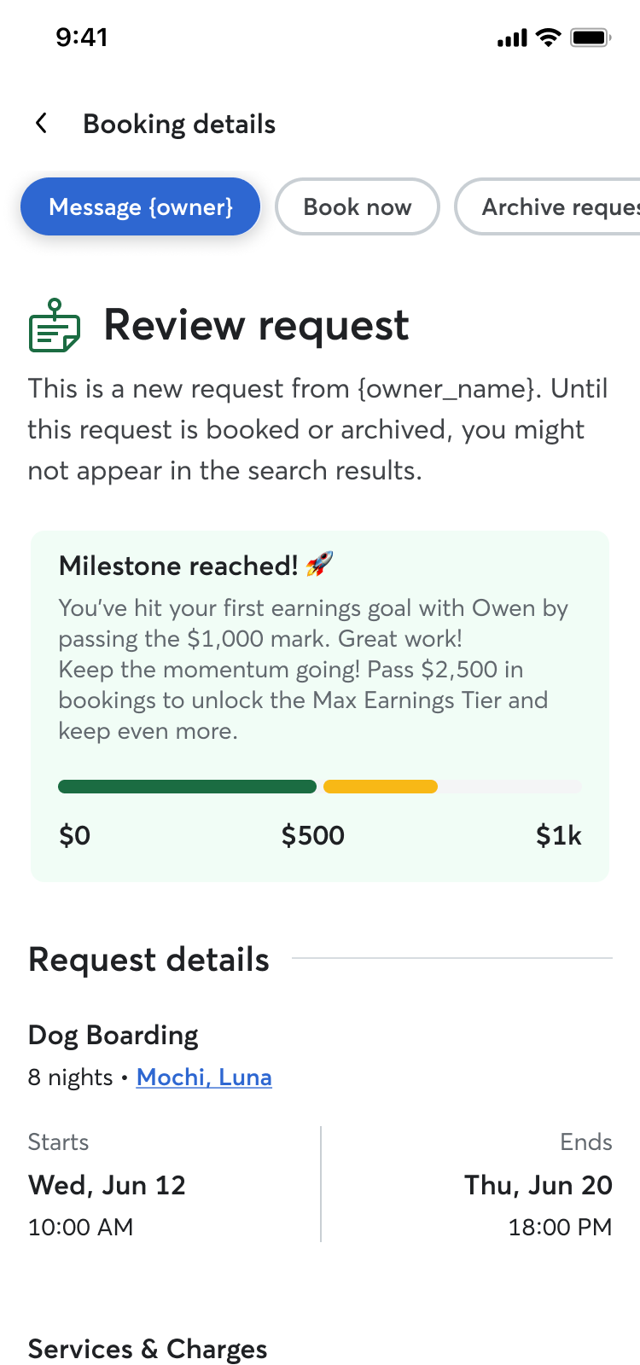
Fee drops as cumulative booking value with a specific client hits milestones.
✓
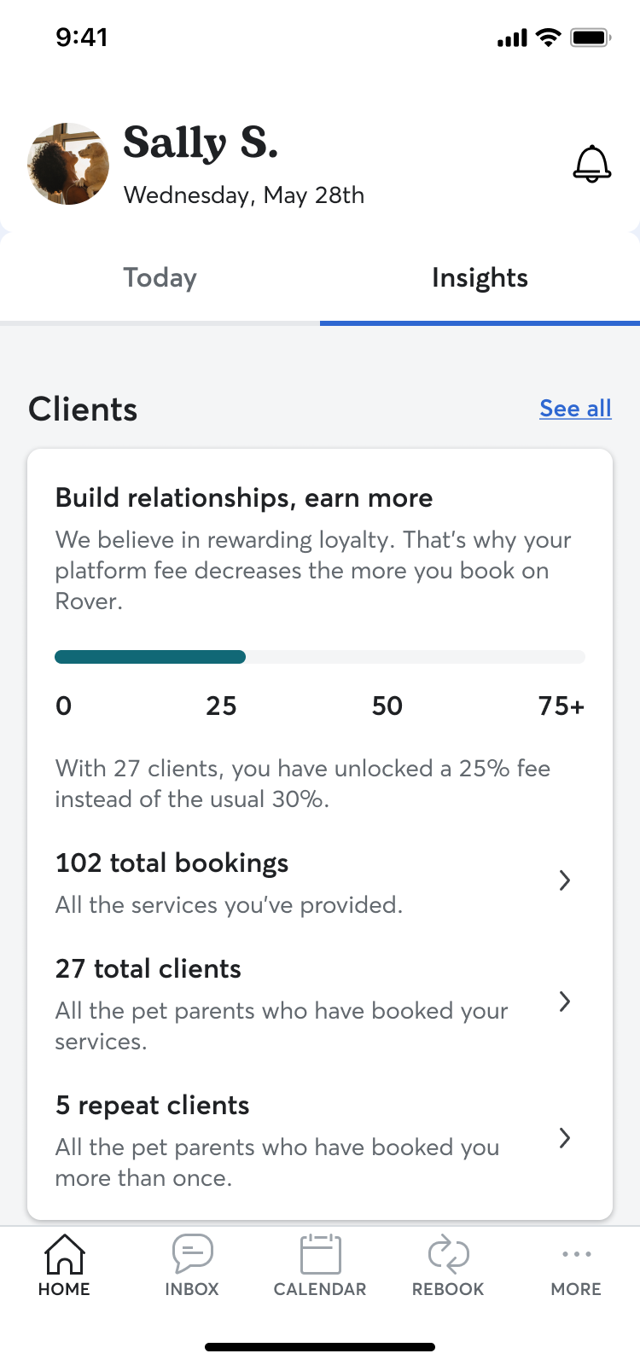
Fee drops as the sitter's total annual Rover earnings hit platform-wide milestones.
✓High mental model match. Sitters track clients, not annual totals. 'This client, this relationship.'
Moderate. GBV threshold mitigates booking-split gaming better than count-based thresholds.
Best match to sitter mental models. Testing first in Canada.
| Dimension | New vs. Repeat | Relationship-based GBV | Account-based GBV |
|---|---|---|---|
| Comprehension | |||
| Fairness match | |||
| Gaming resistance | |||
| Diversion reduction | |||
| Revenue upside |
↑ Relationship-based wins on fairness match — the dimension most directly tied to diversion behaviour
Account-based is operationally cleaner — one annual GBV number, simpler engineering. But when we talked to sitters, every grievance was relational: "I've cared for this family for 3 years and I still pay 20%." Relationship-based maps to how unfairness actually feels.
Sitters across 4 segments confirmed: the per-client framing resonated more than an annual platform total.
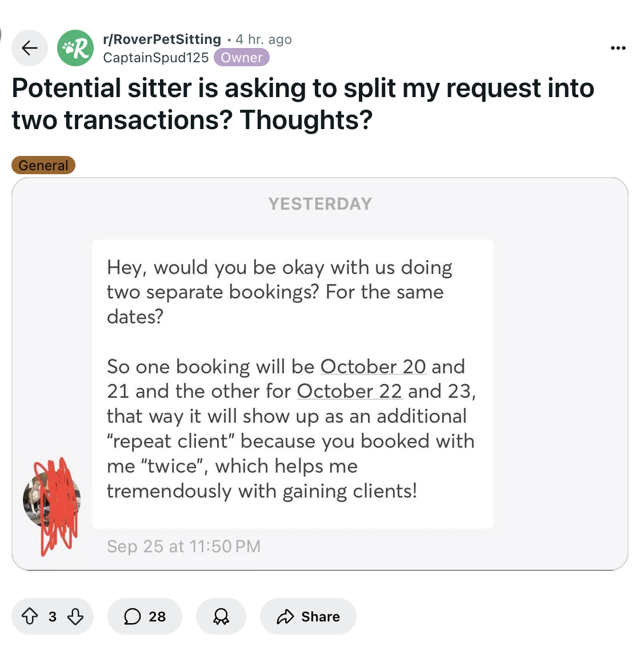
Tenure-only incentives don't address diversion — sitters could use Rover to acquire clients then move them off-platform as their annual GBV grows.
Backlogged as a complementary loyalty track once the relationship model is validated. Not abandoned — sequenced.
From the first analytics deep dive to a live pilot in Canada, then the US next. Click any milestone to expand detail.
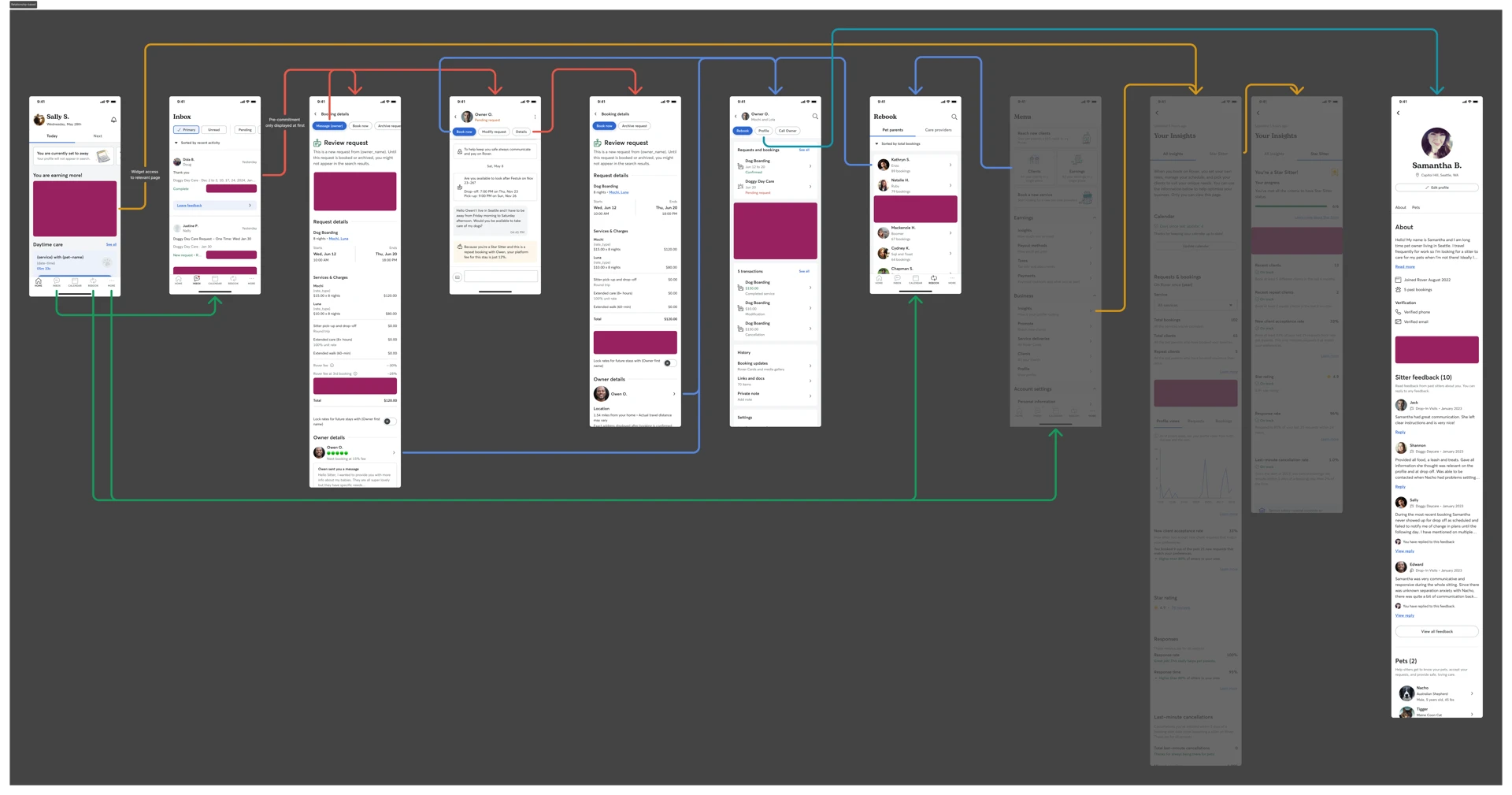
Every surface a sitter touches was considered — from the first announcement to a booking that crosses a tier mid-stay. Click any story to expand.
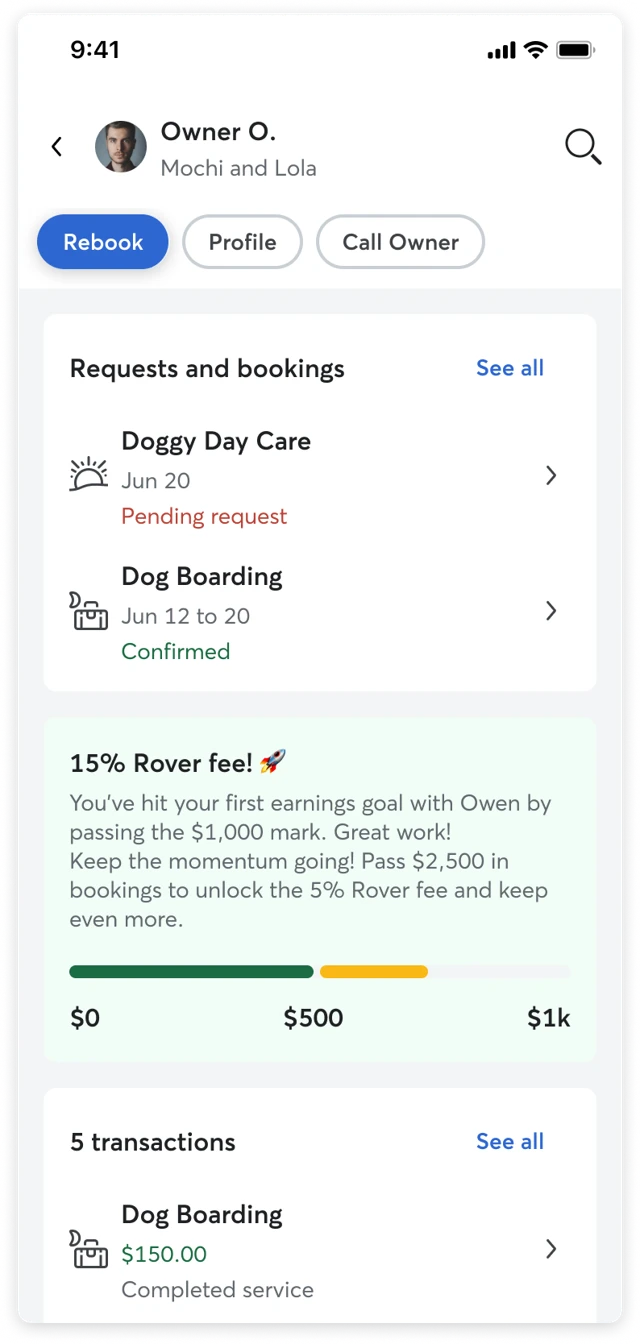
5–6 sections: header (Rebook + Profile CTAs), progress (tier visualisation + progress bar + banner), upcoming bookings, completed bookings, archived, and pets. Entry points: Contacts tab, conversation header, conversation menu, and booking earnings breakdown. Dark green = completed GBV; light green = pending GBV.
Without it, the fee model is invisible. Sitters can't verify their tier, track progress, or understand why a fee changed on a specific booking. It's not a nice-to-have — it's what makes the model real.
Sitters must know how and when they'll gain more value
New and existing sitters must know they're rewarded for keeping bookings on-platform
Everything focuses at the relationship level — not platform-wide
You don't need to understand the model to use it — you just need to see your progress with this client.
Relationship page MVP · Figma · Feb 2026
The fee model only works if sitters encounter it at the right moment — not just once in a landing page. Five distinct surface types, each with a specific job.
Touchpoints overview · Figma · deep-dive doc
Click any card to see what we considered and what we decided.
Cumulative GBV, milestones, permanent reductions — that's four mental models at once.
Options: (A) Show all the maths up front. (B) Progressive disclosure — anchor on 'this relationship with [client name]', reveal mechanics only when needed. (C) Full onboarding flow before first booking.
→ Progressive disclosure. The relationship page is the source of truth; sitters don't need to understand the model to use it — they just need to see their progress. Avoided overwhelming with rules at announcement.
GBV thresholds favour boarding ($300/stay) over walking ($20/walk). Is that fair?
Options: (A) Accept asymmetry in v1, anchor messaging on relationship not maths. (B) Service-specific thresholds. (C) Points-based system where different services earn at different rates. (D) Count-based milestones (5th booking) — equal across services but gameable.
→ Accepted asymmetry in v1. Boarding drives 53% of top sitter earnings; it's the right place to test. Messaging focused on the relationship benefit, not the threshold value. Points system backlogged as a future iteration.
Progress toward a milestone depends partly on whether the owner chooses to rebook — not just sitter quality.
Options: (A) Surface progress as purely dependent on the relationship (honest but demotivating). (B) Focus UI exclusively on actions the sitter controls — booking on-platform, sending post-stay messages, rebooking nudge. (C) Explicitly tell sitters that owner repeat rate is a factor.
→ Focus on sitter-controlled actions. Never show progress as dependent on owner behaviour. UI surfaces: "Book on Rover", "Remind client to rebook", "Send post-stay message" — avoid showing "waiting for client" as a progress state.
A single booking crosses a tier boundary mid-transaction. How is the fee applied?
Options: (A) Split fee — first portion charged at old rate, remainder at new rate. Accurate and honest, but creates a blended fee on one ledger line. (B) Cashback — full booking at the old rate; credit issued for the next booking. Simpler ledger display but delayed reward, requires a credit wallet.
→ Split fee. Most transparent — sitters get the benefit the instant they earn it. The ledger complexity is manageable with a clear breakdown modal (US5). Cashback backlogged; at relationship level threshold crossings are recurring, making it a meaningful future incentive loop.
Average training relationship GBV is ~$500 — meaning virtually all trainers stay at 30% forever. Off-platform, trainers earn $300–350/client vs. $100–130 on Rover. A 30% Tier 1 makes that gap worse.
Five paths were explored. Click each to read the trade-off.
Training and Grooming excluded from the graduated take. Flat 20% applies; they don't count toward relationship GBV progress. No fee callouts in Training conversations. Mixed relationships (core + training) get two separate sections.
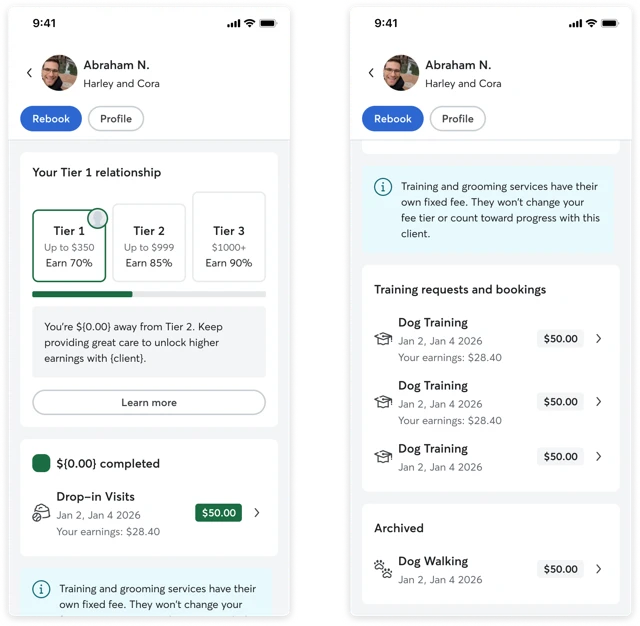
Mixed relationship (core + training) · design exploration · Apr 2026
Qualitative 1:1 interviews, 60 min each, remote via Google Meet. Canada market. Oct–Nov 2025 — before a single line of code was written.
Researcher: Lizeth Herrera
Stakeholders: Mégane Martinez, Bernardo Prudêncio, Guillem Pons (CPO)
The principle of "higher fees at the start, lower as the relationship deepens" was understood and felt fair across all segments in theory. Sitters intuitively grasp that Rover provides most value upfront.
The mechanics — cumulative GBV, milestone triggers, permanence, scope per client — created significant friction independent of the starting fee. When 47% was shown, fairness perceptions collapsed.
Starting fee tuned to 30% (not 47%). Comms strategy shifted to lead with the "why" before the maths. Backfilling historical GBV at launch was a direct response — sitters enter already winning.
"I've cared for this family for 3 years. I know their dog, I know their home, I know their schedule. And I still pay the same 20% as on day one."
Established sitter · concept test · Canada · Oct 2025

Social listening & customer feedback · design exploration · Oct 2025
After the smoke test launched, I manually reviewed 100 real sitter–owner conversations from the treatment geo. Dia reviewed each thread against key themes including any organic mentions of tiered incentives or rewards.
No explicit mentions of tiered or graduated fees, rewards programs, or loyalty schemes in any conversation. All pricing treated as a flat per-service outcome of the standard Rover flow. This confirmed the model needs to be actively surfaced — sitters won't discover it organically.
Same sitter and owner, lots of repeat coordination, high trust. "So happy you're available again", "the dogs will be very happy to see you". These are the relationships the fee model is designed to protect — but sitters never reference a program.
Nobody wrote "let's go off Rover." But payment method drift (e-transfer mentions), adjustments handled via SMS, and granular changes made outside of bookings all signal that Rover's perceived marginal value drops as relationships mature.
"I was charged for 2 visits but I counted 3" — no visible before/after diff. Sitters explain platform rules from memory. This reinforced the decision to show clear tier-crossing breakdowns in booking details (US5).
Author: Bernardo Prudêncio · Mar 12, 2026 · 100 conversations · smoke test geo
| Signal | Target | Why it matters |
|---|---|---|
| Sitter comprehension | ≥70% correct on key mechanics | Model only works if sitters understand the incentive |
| Perceived fairness (top sitters) | Net positive sentiment | Core retention risk if fairness scores collapse |
| Diversion — new relationships | No material increase | Validates that higher Tier 1 fee isn't killing acquisition |
| Repeat booking rate (90-day) | +3–5pp vs control | Behavioural proof that Tier 2/3 is changing sitter actions |
Four specific things — not regrets, but what I'd change if I ran this again.
47% of concept test participants showed motivation collapse at a 47% starting fee. We knew this going into the Canada launch but treated it as a business constraint, not a design problem. I'd push for a joint design–finance session to stress-test rate options against comprehension data before they become locked inputs.
The single biggest confusion at launch. We knew it was a question — it was in our FAQ backlog. I'd build a "you're starting at Tier X because of your history" state into the Relationship page from day one, not retroactively via a comms FAQ on April 21.
The mixed-service relationship (e.g. boarding + training with different sitter licences) surfaced late in the project and needed five option cards and a difficult trade-off conversation. I'd pull edge-case discovery into the first sprint, not the last one before handoff.
System messages, announcement copy, landing page, and FAQ all needed more iteration than I'd scoped. Content was brought in at execution. For a model this complex — where comprehension is a primary success metric — content strategy needed to be a first-class input from the first prototype.
Senior Product Designer · Monetisation & Provider Experience
Relationship-Based Graduated Fees · Rover · Canada live · March 2026